Table of contents
For many people, karting isn’t just motorsport — it’s a great way to unwind after a working day and ride around in mini-cars. Here you can shed stress and catch a wild rush of speed, feeling like a real pilot. The main thing is that absolutely anyone can get behind the wheel. Just book a spot at the Airman karting track, where you’ll immediately be given a car, a helmet and a suit. But to avoid trailing behind and to confidently take the corners from the very first lap, it’s better to learn the basics of karting: how to drive correctly and which mistakes to avoid — such knowledge will really help in practice.
Karting driving technique – where speed begins
Before accelerating to the maximum, you need to learn to feel the car. In fast kart driving, absolutely everything matters: how you sit, how you press the pedals and how you take the corners.

The secrets of kart driving: your seating position matters
The pilot’s body is the main ballast and the heaviest moving element of the whole construction. Any shift of the torso instantly changes the weight distribution between the axles, and that directly affects the tyres’ grip on the asphalt. So before pressing the pedal, you need to firmly wedge your pelvis into the corner of the seat and press your back fully against the seat shell. It’s this position that lets the pilot feel the slightest oscillations of the rear axle, the start of a skid or a loss of wheel grip.
You should keep your knees slightly bent. If your legs are in a different position, you can lose precision when metering the braking effort. And if there are bumps on the track, you can take a strong cumulative impact on your joints.
When you get advice on how to control the kart, the instructors will recommend fixing your palms on the wheel in the classic racing position of “9 and 3” (or “a quarter to three”). Your elbows should stay slightly bent and relaxed.
Pay special attention! While driving, never steer with one hand. Also don’t try to shuffle-steer. The fixed “9 and 3” grip is the golden rule. It guarantees full control of the car in any hairpin or high-speed bend.
Recommended services
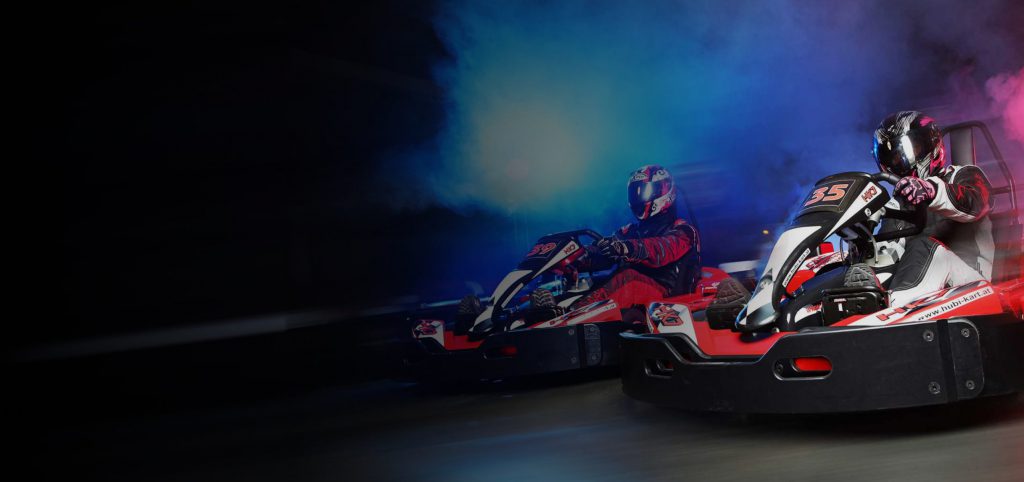
Karting in Lviv
Ninebot GoKart Pro – experience the thrill of being a real racer. The karting can be used by…
Learn more
Karting for Kids
Ninebot GoKart Pro is a chance for children to feel like real racers. The kart is designed specifically…
Learn moreHow to drive a kart correctly: a few words about working the pedals
A kart has two pedals: the accelerator on the right, the brake on the left. Since you control them quite differently from an ordinary car, you need to understand well how to drive a kart. First, never press both pedals at once (unless it’s a special sports kart), because it can lead to clutch overheating and loss of speed.
Second, never use aggressive braking. It’s only possible on a straight line — when the wheels are pointing straight. You should press the brake hard and briefly, gradually releasing the pedal before the start of the corner.
Third, you should press the accelerator smoothly but confidently after exiting a corner. A sharp “hit” on the pedal can cause wheelspin or a rear-axle slide, which instantly reduces your speed.

How to control a kart correctly: taking corners
If your goal is not just riding but also racing (sooner or later), you need to understand that races aren’t won on the straights. The racer’s main task is to take the corner with the highest possible speed on the exit. There are several types of corners: 60 degrees and less — a kink or smooth curve; 60–90 degrees — a simple corner; over 90 degrees — a sharp one; 180 degrees — a hairpin. But how do you correctly enter a corner in karting? Here are the rules to follow:
- In any corner the key rule is “slow in, fast out”: it’s better to shed a little speed before the corner than to enter too fast and lose control. Note! If you ignore this rule, the chances of the kart spinning or flying off the track increase significantly.
- Braking must be finished before you turn the wheel — in the corner the kart should roll freely, without skidding or locking the wheels.
- Choose your line by the “outside–inside–outside” principle: enter from the outer edge, apex on the inside, exit back to the outside.
- In long sharp corners (over 90°) it’s worth taking a later apex — this lets you get on the gas earlier and gain time on the exit.
- In a hairpin (180°) it’s often useful to load the outer rear wheel as much as possible, entering on a wide arc, so as not to flip the kart or lose the rear.
You should also remember that in karting corners are won not on the entry but on the exit, because speed on the straight after the corner matters more than speed at its apex.
Kart driving technique: the most common mistakes
Although a pilot may know how to drive a kart correctly, no one is immune to flaws. The most common mistakes:
- the wrong hand position on the wheel — some people ignore the “9 and 3” advice;
- braking that’s too soft;
- mistimed corner entry;
- trying to give way to other pilots.
Karting is pure excitement that keeps both beginners and experienced racers coming back to the wheel again and again. The main thing is to figure out how to drive a kart, and over time you’ll be able to compete confidently even with the pros.
FAQ
I'm really drawn to karting, but I can't overcome my fear of speed. What should I do?
The main thing is to know how to drive a kart correctly and gradually build up the pace. There’s no need to give it your all from the very first lap. First, drive at a calm pace and learn the track.
The kart is starting to skid. What should I do?
Don’t panic and don’t slam on the brakes. Turn the wheel in the direction of the skid and ease off the accelerator slightly, but don’t drop it completely. When the kart straightens out, return the wheel to its original position and continue.
How do I choose the gear?
Very simply – it should be your size. Only then will you feel comfortable while driving.
Do I need to take weather conditions into account?
Yes. If the surface is wet or covered with sand, your speed should be lower.
How long does it take to learn to drive fast?
Many beginners ask how to learn to drive a kart fast. Unfortunately, it won’t happen quickly: you need knowledge and practice. Some learn in 4–5 months, and for others even a year isn’t enough.
Article author

Other services

Wind Tunnel
Our wind tunnel is a combination of emotions and freedom. Feel the joy of flight, the touch of…
Learn more
Flight Simulator
Flight simulators on moving platforms with real instruments and controls will provide a sensation of a real flight.…
Learn more
Gift certificates
Airman is the epicentre of your emotions! Give certificates for a wind-tunnel flight, karting races or flight-simulator sessions.…
Learn more